

You’ll start your day with five grounding breaths, a 1–3 minute breath-centering practice, then pick one vivid scene and spend 2–5 minutes sensing location, sounds, textures, and a dominant positive emotion. Write one present-tense “as if” sentence and record a tiny inspired action to do within 24–72 hours. Use a small vision board and a brief daily viewing ritual, anchor feelings with a physical cue, and repeat consistently for shifts — keep going to learn practical steps and templates.
Key Takeaways
- Start each morning with 5 grounding breaths and a 1–3 minute breath-centering (inhale 4, hold 1, exhale 6) to calm and focus.
- Choose one specific scene, add 3–4 sensory details, and hold a dominant positive emotion for 30–90 seconds during a 2–5 minute rehearsal.
- Finish each practice by writing one present-tense “as if” sentence and one small inspired action to complete within 24–72 hours.
- Use physical anchors and a visible mini vision board (12–20 images) placed where you’ll see it 2–3 times daily to reinforce neural encoding.
- Rotate 3–5 scenes, read scripts aloud for 21–30 days, and track a one-line daily log for 21–30 days to notice shifts and momentum.
What Is Visualization and Why It Works
While you might think visualization is just daydreaming, it’s a focused practice of forming vivid mental images of a desired outcome and pairing those images with the felt emotions you want to experience; this clear, sensory-rich rehearsal aligns your subconscious with the goal and primes you to notice opportunities and take inspired action.
You’ll use visualization techniques and creative visualization to rehearse success, engaging the subconscious mind through specific mental images and sensory details. Emotional alignment—feeling joy, gratitude, or confidence—signals your brain to strengthen neural pathways, so with consistent practice, vision boards, journaling, and small inspired action, progress follows.
Morning Meditation to Center Your Intentions

When you wake, spend 3–10 minutes settling in with five deep grounding breaths to move awareness into your body and calm the mind.
Then pick one scene from your rotating list of five and picture its location, sights, sounds, and textures so the details feel real. Anchor the visualization by invoking the matching emotion—joy, gratitude, or freedom—and finish by noting one sentence in your journal that states the outcome as already true.
Quick Breath Centering
Often within minutes of waking, spend 1–3 focused minutes on a simple breath count — inhale 4, hold 1, exhale 6 — to slow your heart rate and shift into a calm, receptive state before you visualize. You sit with grounded posture, feet steady, spine tall, using breath counting while drawing attention to your solar plexus. On each exhale, say a brief intention phrase (e.g., “I attract abundance”). Maintain consistent timing as a morning routine and track a one-line daily log for 21–30 days. Notice shifts in emotional vibration and inspired actions; this primes your manifestation practice.
| Step | Focus |
|---|---|
| 1 | Breath counting |
| 2 | Solar plexus |
| 3 | Intention phrase |
| 4 | Daily log |
Scene Selection & Feeling
After your breath centering, pick one clear scene to inhabit during your morning meditation — a specific place, the people involved, and a single outcome you want to feel as real.
You use a cue routine (open window, cup of tea, or two deep breaths), then spend 3–10 minutes placing yourself inside with vivid sensory details.
Rotate through 3–5 scenarios so scene selection stays fresh.
Pair the mental imagery with a dominant positive emotion and finish in your manifestation journal with one present tense “as if” sentence.
Benefits: neural encoding, motivation, clearer goals, habit formation, measurable progress.
Crafting Powerful Mental Rehearsals

Start by choosing one clear outcome and picture the scene for a few minutes so the first three sensory details come alive.
Let yourself hold a matching emotion—gratitude, relief, or joy—for at least 30–60 seconds, then spend the rest of the practice mentally rehearsing the concrete steps that will get you there.
Finish by noting one small inspired action you’ll take so your visualization converts into forward motion.
Set a Clear Scene
When you create a single, specific scene for your visualization, you give your mind a clear beginning, middle and end to rehearse—picture where you are, who’s with you and exactly what you’re doing, then “walk through” it for 2–5 minutes so the sequence feels familiar.
You set a clear scene using sensory details and anchoring techniques. State a present tense outcome, add an emotional anchor, and rehearse daily, repeating the same mental walkthrough.
- Choose one location and people
- Name the present tense outcome
- Add 3–4 sensory details
- Hold the chosen emotion 30+ seconds
- Repeat 3–7 days
Engage Feeling Fully
Though you’ve already named the outcome, spend the first 30–90 seconds deliberately feeling the emotion you expect to have when it’s achieved—gratitude, relief, pride—and let that feeling fill your body so the rehearsal isn’t just a picture but an embodied experience.
In your visualization exercises, feel the emotion deeply, then add multisensory detail: sights, sounds, touch, even smell.
Use a short physical cue to anchor the feeling so you can access it later.
Keep sessions brief and frequent as a mental rehearsal, note one inspired action afterward, and treat gratitude practice and consistency of practice as the engine of momentum.
Rehearse the Process
Because real preparedness comes from practice, rehearse the whole process in your mind as you’d on a playing field: imagine the environment, perform each step, anticipate obstacles and decisions, and finish with the successful outcome — all in a continuous 3–10 minute run-through that trains your subconscious to follow the path you want.
You’ll use visualization techniques and mental rehearsals to encode sensory detail and one dominant emotion.
Alternate outcome and process rehearsals, keep consistent practice within your daily routine, and record journal inspired steps to trigger concrete action.
Try these anchors:
- Morning start and pre-sleep repeat
- Full sensory scene
- Step-by-step contingencies
- One strong emotion focus
- Journal next-step commitment
Building a Vision Board and Daily Viewing Ritual
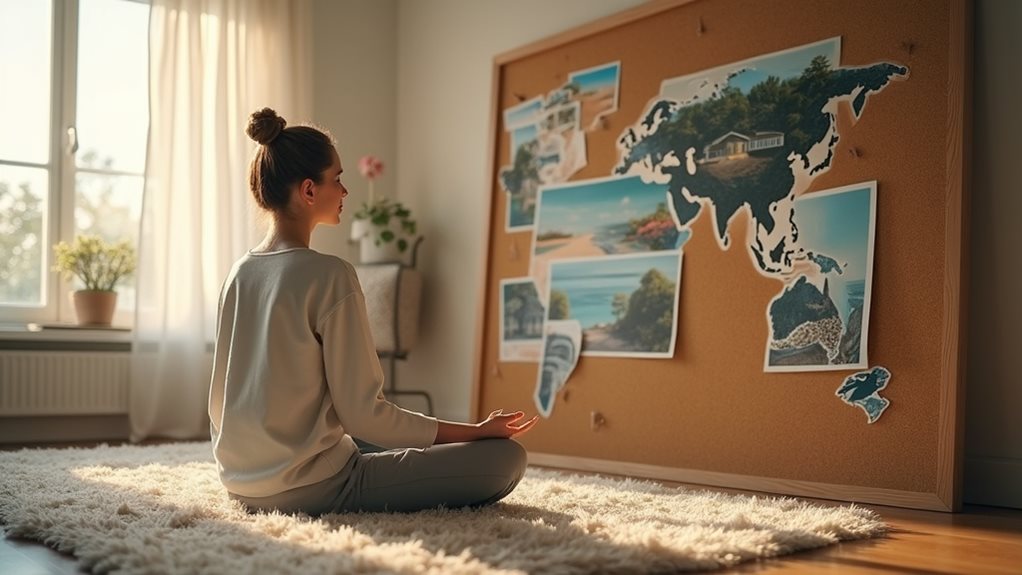
Often you’ll find a small, visible vision board becomes a surprisingly powerful daily cue — pick a 20×30 cm (or similarly visible) board and fill it with 12–20 images, words, and photos that represent specific outcomes (exact house style, job title, monthly income) so your brain can form clear mental targets.
A small, visible 20×30 cm vision board with 12–20 specific images helps your brain form clear, daily targets.
Place it where you see it 2–3 times daily (door, mirror, desk).
Create the board with intention — music, candle, set intentions — then practice a 1–3 minute daily viewing ritual: breathe, scan, and evoke joy or gratitude to raise emotional alignment.
Refresh regularly every three months to keep visualization techniques tuned to manifest your desires.
Guided Hypnosis and Sleep-Time Imprinting

Your visible vision board sets clear targets for your conscious mind; guided hypnosis and sleep-time imprinting take those targets straight to your subconscious where they can steer habits and impulses more quietly but powerfully.
You use guided hypnosis recordings to bypass critique, delivering sensory-rich scene-setting and present-tense affirmations as subconscious suggestion.
Practice daily/nightly for 21–30 days, especially during the hypnagogic state, to help images trigger inspired action.
Choose tracks by qualified professionals and avoid if you have epilepsy or psychosis risk.
Try these focus points:
- vivid sensory detail
- joyful emotion
- short nightly sessions
- consistent repetition
- clear present-tense phrasing
Journaling, Scripting, and the Manifestation Contract

When you sit down to journal or script, treat it like a conversation with your deeper self: write in present tense, layer in sensory specifics and the emotions you want to embody, and sign the page as a small, binding agreement to act.
Spend 5–10 minutes daily scripting one vivid scenario, narrating your current life, noting “miracles,” and ending with the fulfilled scene.
Create a written manifestation contract naming the desire, the emotional state (gratitude, abundance) and two aligned actions within seven days.
Date and sign entries, read scripts aloud for 21 days, review weekly for synchro nicities, and revise to keep the subconscious engaged.
Bringing Visualizations Into Everyday Actions
Regularly translate your visualization into small, practical steps so the images you hold actually change your day-to-day behavior. You’ll use visualization techniques to turn vision into habit: after each session, note one inspired action and finish it in 24–72 hours. Use micro-behaviors that mirror your imagined self and create a vision board where environmental triggers prompt a single task.
Turn visuals into habit: pick one inspired action, do a micro-behavior, and set triggers to finish it.
When doubt appears, run a brief process-visualization of the next step to restore a positive mindset. Track measurable progress by converting images into metrics and review weekly so you consistently visualize your goals and sustain momentum.
- Write one inspired action
- Do a micro-behavior
- Place environmental triggers
- Run 30–60s process-visualization
- Track measurable progress
Frequently Asked Questions
How to Use Visualization to Manifest?
You visualize by creating vivid sensory detail, pairing emotional alignment with future pacing, practicing mental rehearsal and belief integration, scripting scenes, building anchors, using outcome detachment, and doing daily microvisuals so you’ll take inspired, consistent action.
What Is the 10-10-10 Rule for Manifesting?
The 10-10-10 rule is a timed practice: you’ll do intention setting and sensory immersion (10 minutes), scripting with affirmation pairing (10 minutes), then emotional calibration with symbolic objects, micro commitments, progress tracking and subconscious priming (10).
How to Do Manifestation Daily?
You’ll supercharge results: start mini meditations each morning ritual, do energy clearing, use sensory anchoring and visual cueing, pair affirmation pairing with goal scripting, write progress journaling, practice gratitude integration, and take inspired action throughout the day.
How Often Should You Visualize to Manifest?
You should visualize daily, aiming for morning and evening sessions plus midday micro visualizations; use mental rehearsal with sensory detail, cue triggers and habit stacking, keep short visualization duration, track progress, and maintain strong emotional intensity and timing frequency.
Conclusion
You’ve learned practical ways to shape your day with clear mental practice — and you’ll see results faster if you stick with them. Studies show people who visualize daily are 1.5 times more likely to achieve their goals than those who don’t, so your effort pays off. Keep your morning meditations, vision-board viewings, journaling, and tiny daily actions consistent. Be gentle, stay curious, and trust the process: small, steady steps manifest big change.